We currently offer six products and services that we can build with you.
Every one of them started as a problem we lived inside a hospital: the rounding note nobody answered, the dashboard nobody opened twice, the margin initiative nobody could prove. Each one runs on the reports your teams already produce, holds no patient data, wears your organization's name and colors, and gets built with you in days. That is the low cost, high value way to put AI to work where you work.
We can partner with you to build what this would look like at your organization. Two ways to have one. We build it with you, one organization at the table, on your own inputs. Or we hand your engineers the build specification, the document that says what goes in, what the screens are, how it decides, and what it never touches, and they build it themselves.
Our goal is to empower healthcare leaders to leverage AI.
Every number on this page was produced by the working prototype from demonstration data. No client is behind these numbers, and nothing here is installed at a hospital yet. That is deliberate. We build one product at a time, with one organization at the table, and the inquiries on this page set the build order. The first serious conversation on any card moves it to the front.
No product on this page holds patient data. Aggregated and de identified inputs, no Epic connection, no business associate agreement to sign. A business associate agreement is the contract that governs patient data at a vendor, and none of these tools needs one because none of them ever sees a patient record.
Build it with us, or build it yourself.
01 // Two ways to have oneOne organization at the table, your own inputs, a named owner on your side and one on ours. We put the prototype in front of your team, adapt it to your rules and your exports, and it goes live with a baseline, a reviewer and a review date, because that is the standard we teach.
The build specification is the full document: what goes in, every screen, how it decides, the rules we already settled, and what it never touches. Your engineers build from it. You pay for the document, and we are one call away when they have a question.
Six products and services we can offer to you.
02 // The sixHere are the six. Every picture is what the tool looks like inside a hospital, in that hospital's own colors, because every one of them is white labeled to you. Open any card for what it does for your organization and what it takes to have it.
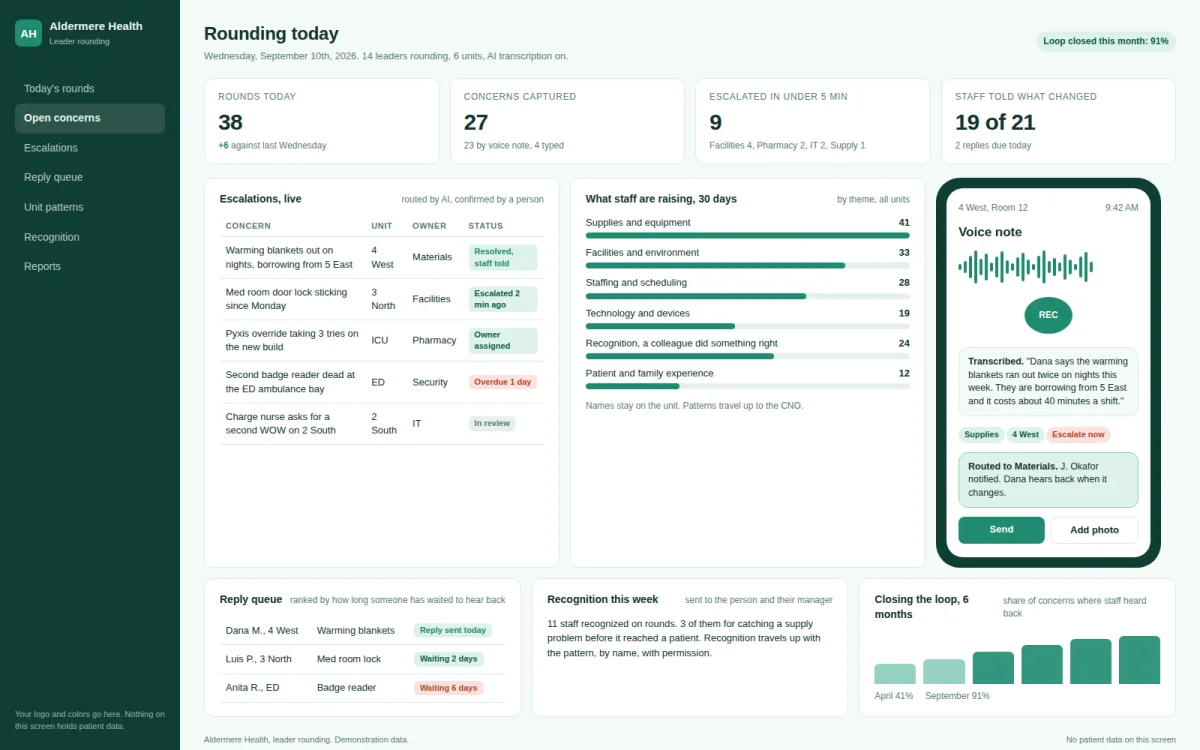
Speak a concern as you walk the unit and it is transcribed, tagged and routed to the right owner before you reach the next room. A facilities problem escalates in minutes rather than at next week's meeting, and the nurse who raised it hears what changed, which is the one thing most rounding programs never do. Our board member Madison Workman, Chief Operating Officer at Broward Health North, said it plainly when he saw it. Leaders log into their rounding app today, click through the questions and type free text, and this one could be “a nice little home run for a lot of organizations.”
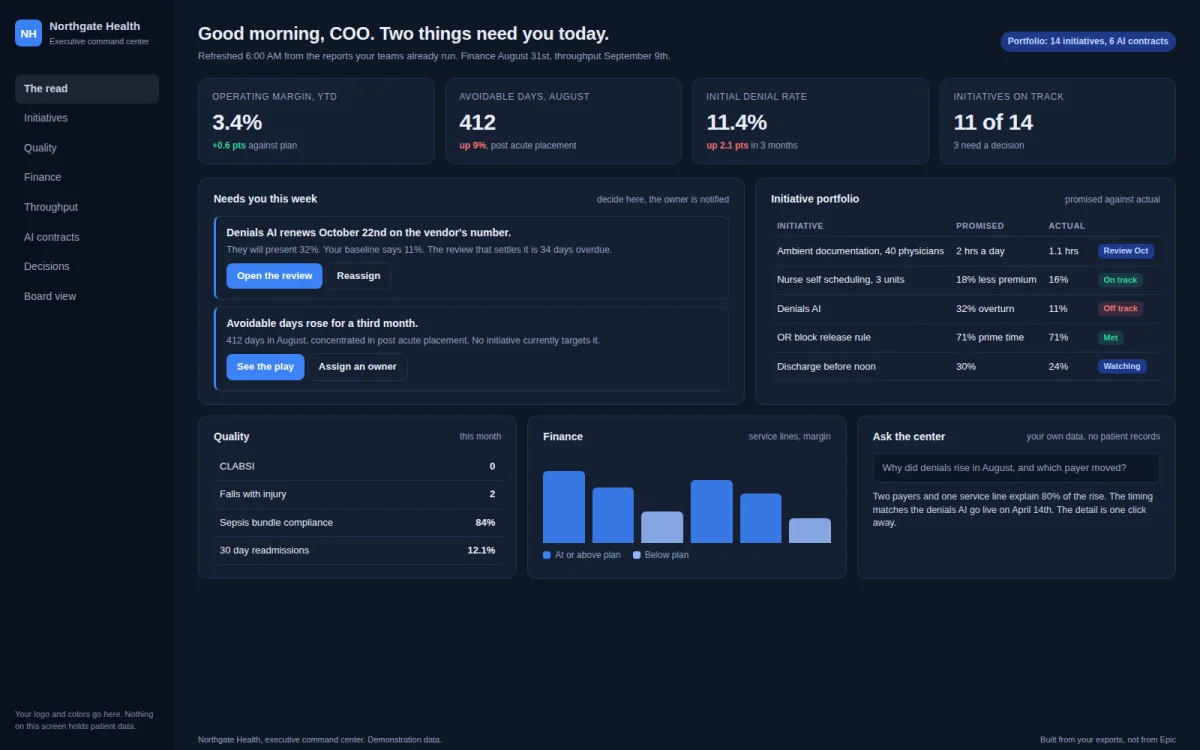
The CEO, the COO and the director of pharmacy can each have their own. It reads the reports your teams already run, Epic exports dropped into a folder. Then it opens on the two things that need you today rather than on a wall of metrics: is anything broken, what needs me, and is the thing we paid for working. We build yours from a conversation with your team, in days, and it looks like your organization rather than ours.
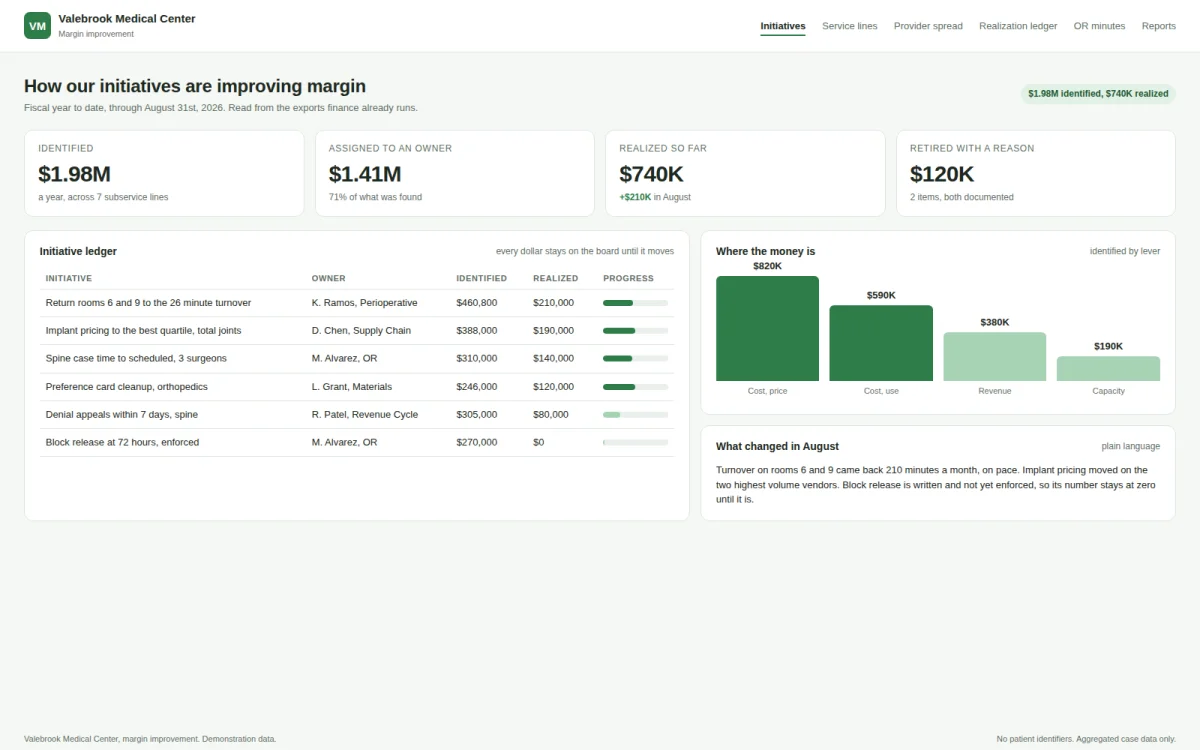
You have a dozen initiatives meant to improve margin and no single place that says which ones are working. YIELD reads the reports finance already runs and keeps a ledger of every dollar: identified, assigned to an owner, realized, or retired with a reason. It shows you why your financial performance is what it is and what your options are, lower cost, higher revenue, or something outside your control, so the answer is a number instead of an anecdote about GLP-1s.
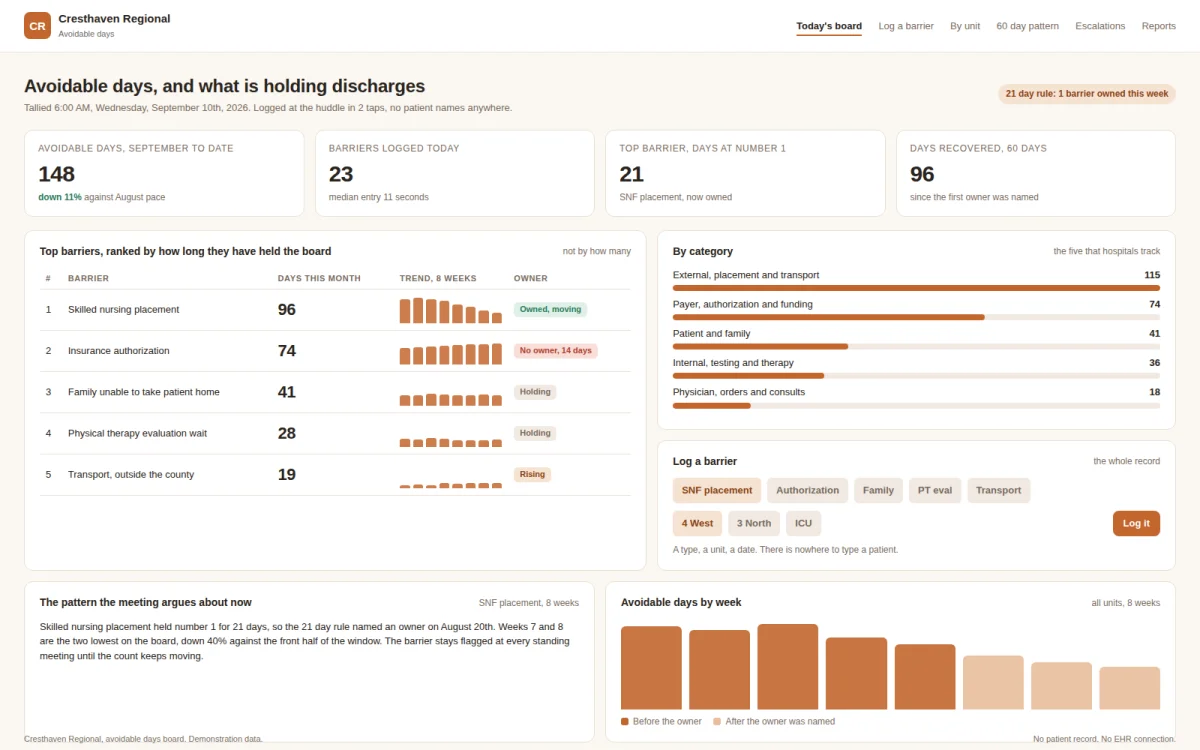
Avoidable days are the extra days a patient spends in a bed after the care is done, and most hospitals count them after the fact, when the reason is gone. BARRIER logs the reason at the morning huddle in 2 taps, with no patient names anywhere, and turns 60 days of reasons into a pattern the meeting can act on. It spots the outliers early, and the 21 day rule turns the barrier that will not move into somebody's assignment.
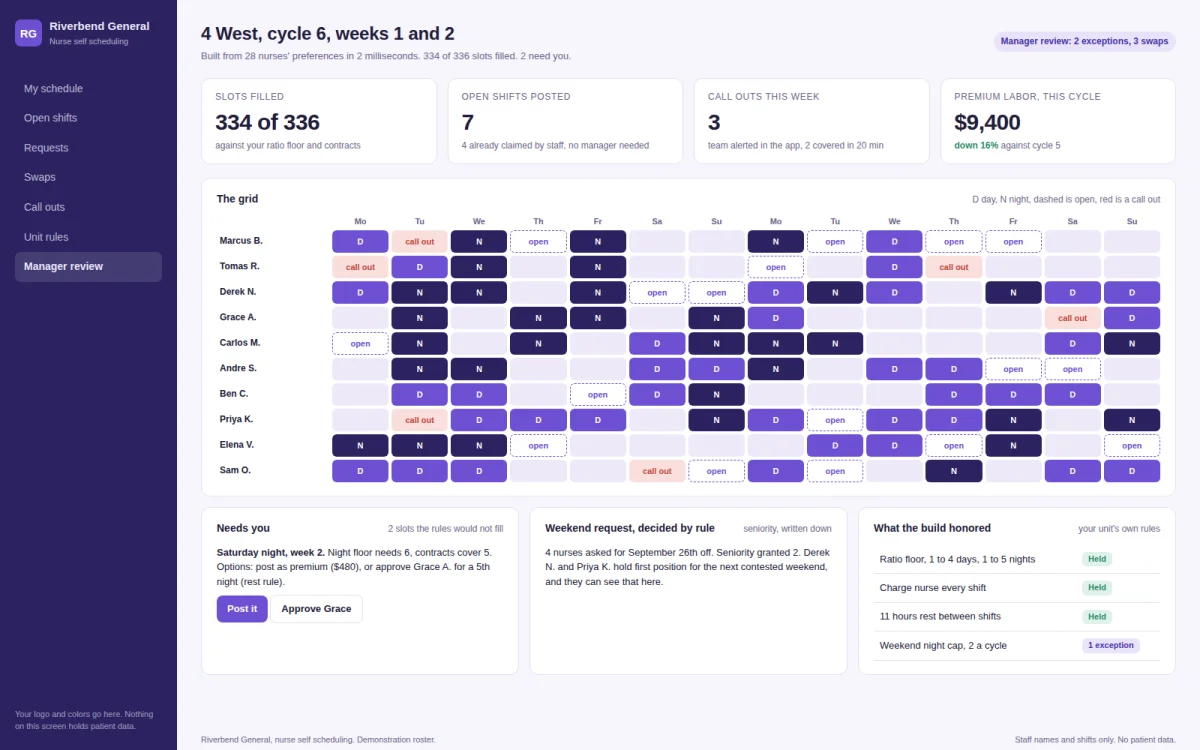
Built first for a real hospital unit, and it could replace the scheduling system you have. Nurses see who is working, pick their shifts, post a call out that alerts the whole team, and pick up an open shift without waiting on a manager. The tool builds the full 6 week schedule against your ratio floor, skill mix, contracts and seniority, then tells you the truth about the 2 slots it could not fill. White labeled to your organization, no patient data.
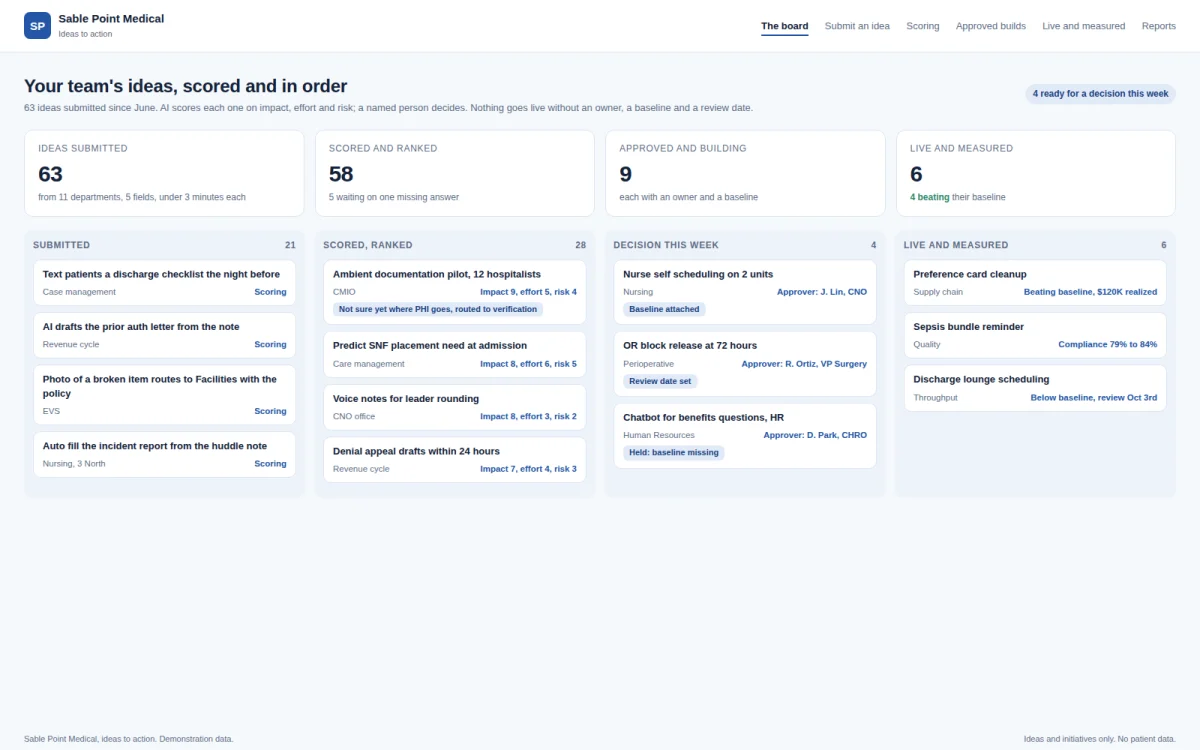
Every hospital has more good ideas than time. CHARTER gives your staff one place to submit a system idea in 5 fields and under 3 minutes, scores each one on impact, effort and risk with AI, and puts them in order for a named person to decide. Nothing goes live without an owner, a baseline and a review date, so the ideas that get built are the ones you can prove worked, and the AI tool a vendor is selling you gets measured the same way.
We build one product at a time. The first serious conversation on any card moves that card to the front, and you shape it as the design partner, so tell us which problem is yours.
Decision Packs.
03 // Decision PacksWe offer a variety of playbooks for your consumption, and we can build them with you. A Decision Pack is the one page a leader needs at the moment a decision arrives, plus a working tool. An Operategy Playbook is the longer form: one workflow, one problem, what the evidence says, and the move.
Each is one page plus a working tool, and the first seven, being written now, cover baselines, decision rights, rollback plans, vendor claim tests, contract clauses and monitoring standards.
Included with membership. Two are free with an email ask, because they start conversations.
One workflow surface, one problem, what the evidence actually says, and the move. A free [Q]Tips at the top, a working tool in the middle, and an engagement where the generic answer runs out.
The [Q]Tips is free, the tool comes with membership, and the engagement is priced per organization.
Four steps from a conversation to live.
04 // How a build worksThirty minutes, and you bring the problem and the exports you already have while we bring the prototype.
We run the prototype on your own inputs and put the result in front of your team. If the number is not there, we say so.
Door one, we build it with you, one organization at the table. Door two, your engineers take the specification and we stay a call away.
It goes live with a baseline, a named reviewer and a date to look again, because a tool with none of those is the problem we built these to fix.
Tell us which problem is yours.
05 // Start hereOne form, one inbox, a reply from a person within two business days.
Or write to info@thequadco.ai